With the first X-Tri Series event just around the corner (hello Squamish Off-Road Tri!), we sat down with Victoria’s Robin McDaniel, an age group Cross-Triathlon racer who went on to qualify 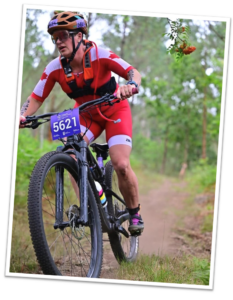 and compete at the 2025 World Championships. In this interview, we chat all things off-road, and her amazing journey to represent Canada in Pontevedra.
Triathlon BC: Can you tell us a little about your background in sport and how you first became involved in triathlon?
Robin: I grew up around triathlon. My father, Brian McDaniel, was the founder of the Cowichan Challenge Triathlon in 1979. I remember watching him compete in local road triathlons and later at the World Masters Games in Portland in 1998. My family and I volunteered at a lot of races from a young age—I loved the atmosphere and the joy of watching adults have fun.
I come from a very athletic family, but I never saw myself as a “real” athlete. I’ve always loved the outdoors and adventure but I didn’t feel like I fit the mold of what I thought an athlete should look like. Weight challenges related to polycystic ovarian syndrome (PCOS), along with a fear of embarrassing myself, kept me from taking my athletic ambitions seriously.
That started to change after I became a mother to two rambunctious boys. I realized I needed time in nature for myself—and that I needed to be fit enough to keep up with them, or they would run me into the ground.
Around that time I met a dear friend, Lydia Pedri, who shared my love of being outside and helped to awaken my quiet athletic ambitions. Together we carved out time to run, mountain bike, and open water swim. Eventually Lydia suggested we put it all together and try the Dodge City Cross Triathlon. The atmosphere of fun and challenge at that off-road triathlon really lit a fire in me.
For me, triathlon is really a story about parental modeling, finding belief in yourself, and the power of community.
Triathlon BC: What initially drew you to the world of off-road triathlon, and how does it compare to traditional road triathlon in your experience?
Robin: I have relatively limited experience with road triathlons—I’ve completed the Cowichan Challenge and the Westwood Lake Triathlons—but I’ve spent many years mountain biking and love being on the trails. Because of that, trying an off-road triathlon felt like a natural fit.
From my perspective, off-road triathlon is significantly more challenging. It demands stronger technical skills on the bike and more agility on the run, and the courses often include significant elevation. The terrain adds an element of unpredictability that makes it both harder and, for me, more fun.
Triathlon BC: For athletes who may not be familiar with the discipline, how would you describe cross triathlon and what makes it unique?
Robin: Like a traditional triathlon, cross triathlon starts with an open-water swim, followed by a bike and then a run. The difference is that the bike is on a mountain bike and the run is on trails. Distances are usually sprint or standard, and while the bike leg is shorter than in a road triathlon, it often takes just as long because of the terrain.
What makes it unique is the unpredictability. You’re dealing with roots, rocks, elevation, which makes it particularly challenging.
Triathlon BC: What aspects of off-road triathlon do you find the most challenging compared to traditional road triathlon?
Robin: For me, one of the biggest challenges is the lack of true recovery. You’re often working at a very high heart rate on the climbs, and even on descents—where you might expect some relief—you still have to stay focused and in control. My heart rate tends to run high, and at the World Championships I saw it climb to 205, likely a combination of heat, steep terrain, and adrenaline. There’s really nowhere to hide out there.
At the Victoria XTERRA in 2025, I hit a significant wall due to heat, exertion, and under-fueling. The technical nature of the terrain—on both the bike and the run—combined with the elevation meant I had to stay mentally engaged the entire time. I ended up tripping on some roots during the run and injuring my knee, which took a long time to heal. It was a reminder of just how much these races demand.
Triathlon BC: Training for cross triathlon often requires different skills, particularly with mountain biking and trail running. How did your training change as you prepared for these events?
Robin: The first thing I did when I decided to compete at the World Championships was hire a coach—I knew I had a lot to learn in terms of both fitness and skills. I worked with Coach Adam Walker of The Cycling Co., who designed a training program and provided a series of one-on-one mountain bike skills sessions. Alongside that, I incorporated plyometrics, strength training, and brick workouts to prepare my legs for the demands of the trail run after the bike.
I was on the swim team as a child, so I’m a confident swimmer. With limited time and energy, I chose to focus more heavily on riding and running—the areas where I felt I could make the biggest gains.
I also had to learn basic bike mechanics. Traveling with my bike meant figuring out how to pack and reassemble it, which, frankly, did not go smoothly and led me to a very kind local bike shop owner. After all the time, financial, and family investment it took to get to the start line, a DNF was not an option, so I made a point of learning as much as I could about on-course repairs. It ended up being a valuable part of the process, and I was lucky to have people generously share their time and tools to help me learn.
Triathlon BC: Are there specific technical skills athletes need to focus on to succeed in off-road triathlon?
Robin: Bike handling is huge—cornering, braking, climbing, and descending confidently all make a big difference. Being able to ride technical terrain efficiently saves a lot of energy.
Trail running skills matter as well. You have to stay light on your feet and react quickly to roots, rocks, and uneven ground, especially when you’re already fatigued from the bike. Strong descending skills on tired quads makes a difference. I know this, because these are skills I don’t yet have!
Triathlon BC: British Columbia has incredible terrain for off-road sport. How has training in BC helped prepare you for competing in cross triathlon events?
Robin: Interestingly, the trails in BC are far more technical than the course at the World Championships in Pontevedra, Spain. Riding here means navigating punchy rock climbs, roots, burmed corners, and fast descents. In Spain, the course was much milder—I even joked that I could have ridden a gravel bike.
Because of that, I spent a lot of time trying to improve my technical riding skills in preparation. In reality, what I discovered was that my biggest weakness wasn’t technical riding at all—it was my run endurance and strength coming off the bike.
Triathlon BC: You went on to qualify for the World Triathlon Multisport Championships in cross triathlon. What did that qualification mean to you?
Robin: Qualifying for the Multisport Championships was exciting, but if I’m honest, there were very few athletes in my age category. I wrestled with whether I truly deserved the spot.
In the end, I decided it was a rare opportunity and one that I should take. I wanted the experience of training as hard as I could for a major competition.
Triathlon BC: Can you walk us through your race day experience at the World Triathlon Multisport Championships?
Robin: Race day was full of nerves—and logistical challenges. I traveled to Spain on my own while my husband stayed home with our kids, who were nine and six at the time.
Getting to the race venue with my bike turned out to be a sport of its own. The start was outside the city, and I didn’t feel confident navigating Spain in a rental car. My very opinionated—but incredibly kind—Airbnb host ended up driving me and my dismantled bike to the start line in his tiny Fiat. As he dropped me off he said, “Just ride home after!”
It was thrilling to arrive and see Team Canada athletes setting up transition in our red and white. We all walked to the start together, and I loved that moment when we all shared our nerves at the lake edge in our nearly see-through tri suits. The men started in age-group waves every five minutes, while the women had a single mass start.
After the single-lap swim, we transitioned to the 30 km, two-lap mountain bike course, which took me about an hour and forty minutes to complete. I rode my full-suspension Rocky Mountain Element and wished I had a lighter hardtail.
From there we headed onto a hilly 10km single-lap trail run through eucalyptus forest and along the lake.
When I finally crossed the finish line, I felt enormous gratitude to have completed it. At the same time, I felt a little sadness that my family and friends weren’t there to share the moment or help me when I was completely spent. Hours later, when I finally made it back into the city, I was wandering around like a ravenous dog looking for food.
Triathlon BC: What was it like competing on the world stage as an age-group athlete alongside competitors from around the globe?
Robin: It was incredibly inspiring. At the pre-race swim the day before, I remember looking at some of the women’s backs and thinking, “I didn’t even know that muscle existed!”
At the same time, there were plenty of everyday athletes too. I became close with Chris Cox, a fellow Cross Triathlete from Halifax, we pre-rode the course together, contemplated lines, strategized the best way to manage our heart rates and the hills and mocked each other’s tire pressure.
Triathlon BC: Were there any memorable moments or challenges during the race that you’ll carry with you?
Robin: There were both highs and lows, but mostly I felt proud. I’m a working mom with two young kids, and simply getting to the start line required discipline, bravery, and a lot of organization.
On the second lap of the bike course, I was descending and passed a few riders. In that moment, I got emotional and thought, “I’m really doing this.” I hope to never forget that feeling.
There were frustrating moments too. A number of (non-Canadian) men made surprising statements about women in cross-triathlon. During the course, one man I passed said, “Hey sweetie, don’t forget to drink,” which felt condescending—especially since he had started more than ten minutes ahead of me!
Triathlon BC: Off-road triathlon is still an emerging discipline. What do you think is driving its growth and appeal in BC?
Robin: BC is a natural fit for off-road triathlon because we already have such a strong trail culture. People here love mountain biking, trail running, and being outside.
Cross triathlon brings those communities together in a really fun and adventurous way.
Triathlon BC: What advice would you give to triathletes in BC who are curious about trying off-road triathlon for the first time?
Robin: There is no better place than BC to try off-road triathlon. Our terrain is beautiful, but it is technical, so it helps to build some bike handling skills and invest in a good mountain bike.
What stood out to me after racing internationally was how strong the multisport culture is here. The community in BC is inclusive, supportive, and focused on having fun while pushing yourself.
Triathlon BC: Looking ahead, what goals do you have for your future in off-road triathlon or multisport racing?
Robin: Right now I’m connecting with my “why.” After the World Championships I realized my motivation isn’t about being the best—I never will be—and I don’t even love the competitive side that much.
My “why” is health, adventure, and community.
This year I’m racing the BC Bike Race, a seven-day stage mountain bike race at the end of May. I’m doing it as part of a female team with a friend named Francene Benoit who is also a triathlete. Our goal is simple: do our best each day, support each other, and enjoy a big meal with a beer at the end of every stage.
I’m also riding, running and hiking the Vancouver Island Trail with friends, gradually piecing together the route from Victoria to Port Hardy over the year. In between, I’ll likely do a few off-road triathlons like the Honeymoon Bay Half and XTERRA Thunder Bay.
And who knows—you might even see my dad and I make a comeback at the Cowichan Challenge!
Robin: The soapbox you didn’t ask for:
I believe many women hesitate to participate in sport if they feel they might not be the best. I want women to know we belong in these spaces—regardless of body type, speed, or skill level. Showing up and participating at any level is enough.
Race organizers play a big role in making events more inclusive. That could mean longer course cut-off times, fully stocked aid stations for later finishers, or even offering childcare. (Wouldn’t it be fun for kids to help marshal and volunteer while their parents compete—just like I did as a child?) These supports make it easier for more women to participate.
As athletes, we can do our part too. Whenever possible, stay at the finish line. Cheer people in. Celebrate everyone who crosses it. I once heard it said at a particularly emotional finish line, “No one goes home until we all get home.”
***********************************************************************************************
With the 4-event X-Tri Series leading the way, Triathlon BC continues to see strong momentum in off-road racing. Athletes like Robin are helping to inspire the next wave of competitors to test themselves beyond the pavement.
Get Involved.
Ready to take on the trails? The X-Tri Series offers opportunities for athletes of all levels to experience the thrill of off-road triathlon in some of BC’s most spectacular landscapes.
- June 6 I SQUAMISH OFF-ROAD TRIATHLON I Squamish BC
- July 5 I VICTORIA X TRI I Victoria, BC
- September 12 I DODGE CITY X I Cumberland, BC
- September 20 I WHISTLER X TRI I Whistler BC
Whether you’re chasing a World Championship qualification or simply looking to try something new, there’s a place for you on the start line in the BC X-Tri Series.
See you in Squamish in June!